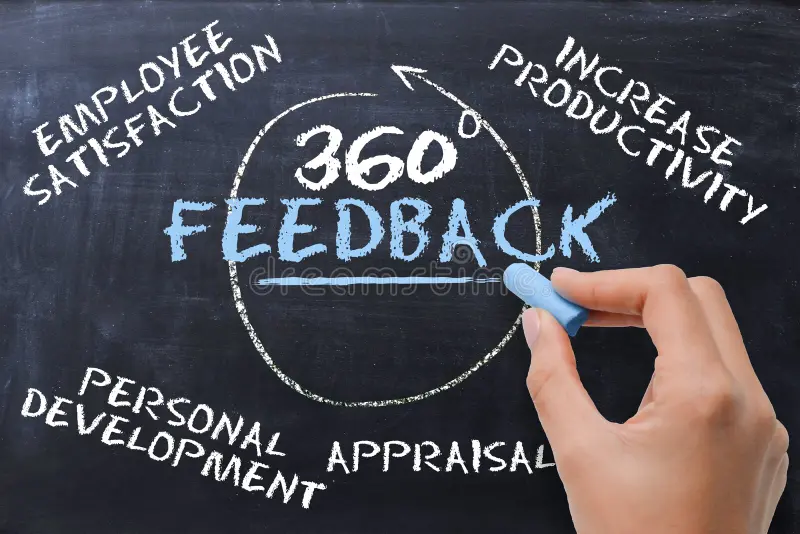
In today’s competitive business environment, organizations are constantly seeking effective ways to improve employee performance and foster professional growth. Traditional performance reviews conducted solely by managers often provide a limited perspective on an employee’s capabilities. This is where 360-degree feedback has emerged as a valuable performance management tool.
360-degree feedback is a comprehensive evaluation method that gathers feedback from multiple sources, including managers, peers, direct reports, customers, and sometimes the employees themselves. By collecting diverse viewpoints, organizations can gain a more complete understanding of an employee’s strengths, weaknesses, and development opportunities.
This article explores the advantages, disadvantages, and best practices of 360-degree feedback, helping HR professionals and managers implement this performance management approach successfully.
360-degree feedback, also known as multi-rater feedback, is a performance evaluation process that collects confidential feedback from individuals who interact with an employee regularly. Unlike traditional appraisals that rely on a manager’s perspective, this method gathers insights from various stakeholders.
Typically, feedback is collected from:
The purpose of 360-degree feedback is not only to evaluate performance but also to identify development opportunities, improve workplace relationships, and encourage continuous learning.
Organizations often use this method for leadership development, succession planning, employee coaching, and performance improvement initiatives.
One of the biggest benefits of 360-degree feedback is that it offers a holistic perspective of employee performance. Different stakeholders observe different aspects of an employee’s behavior, communication, teamwork, and leadership skills.
This broader view helps reduce biases that may occur when performance assessments are based solely on a manager’s opinion.
Employees gain valuable insights into how others perceive their work and behavior. Comparing self-assessment results with feedback from colleagues can reveal blind spots and areas for improvement.
Greater self-awareness often leads to stronger personal and professional development.
Organizations frequently use 360-degree feedback to develop future leaders. Feedback from multiple sources helps leaders understand their impact on team members and identify areas where they can improve communication, delegation, and decision-making.
When implemented effectively, 360-degree feedback encourages open communication and ongoing development. Employees become more receptive to constructive feedback and are motivated to improve their performance continuously.
Because feedback comes from peers and colleagues, employees gain a better understanding of how their actions affect others. This awareness can strengthen teamwork, collaboration, and workplace relationships.
Despite its benefits, 360-degree feedback is not without challenges. Organizations should be aware of potential drawbacks before implementation.
Feedback can sometimes be influenced by personal relationships, workplace conflicts, or favoritism. Employees may provide overly positive or negative ratings that do not accurately reflect actual performance.
Without proper training, feedback quality may suffer.
Receiving feedback from multiple people can feel overwhelming, especially if the comments are unexpected or highly critical. Employees may become defensive rather than viewing the process as an opportunity for growth.
Proper communication and coaching are essential to minimize this risk.
Collecting, analyzing, and discussing feedback from multiple sources requires significant time and administrative effort. HR teams may need dedicated tools and resources to manage the process efficiently.
Employees may misunderstand feedback or focus excessively on negative comments. Without guidance from managers or coaches, valuable insights may not translate into meaningful development actions.
Many experts recommend using 360-degree feedback primarily for development purposes rather than compensation or promotion decisions. When linked directly to rewards, participants may manipulate responses, reducing the accuracy of the feedback.
To maximize the effectiveness of 360-degree feedback, organizations should follow several best practices.
Before launching a feedback program, determine its purpose. Is the goal leadership development, employee coaching, succession planning, or performance improvement? Clear objectives help ensure the process delivers meaningful results.
Participants are more likely to provide honest feedback when they know their responses will remain confidential. Anonymous surveys help increase trust and encourage candid input.
Provide training on how to give constructive feedback and interpret results effectively. Employees should understand that feedback is intended to support growth rather than criticize performance.
The primary purpose of 360-degree feedback should be employee development. Encourage participants to create action plans based on their feedback and set measurable improvement goals.
Choose standardized questionnaires that evaluate relevant competencies such as communication, leadership, teamwork, problem-solving, and adaptability. Reliable tools improve the accuracy and consistency of feedback.
Feedback alone does not drive improvement. Managers and HR professionals should conduct follow-up discussions, provide coaching, and monitor progress regularly.
Organizations should integrate 360-degree feedback into their ongoing performance management process. Annual or semi-annual assessments help track progress and reinforce continuous development.
360-degree feedback has become an essential component of modern performance management systems. By collecting feedback from managers, peers, direct reports, and customers, organizations gain a more comprehensive understanding of employee performance and development needs.
The process offers several advantages, including increased self-awareness, improved leadership development, stronger collaboration, and a culture of continuous improvement. However, organizations must also address challenges such as feedback bias, employee anxiety, and implementation complexity.
When supported by clear objectives, confidentiality, training, and ongoing coaching, 360-degree feedback can become a powerful tool for employee growth and organizational success. Companies that implement this approach effectively are better positioned to develop high-performing teams and create a workplace culture focused on learning and continuous improvement.